Posts

Showing posts with the label review

Reading the Classics: Review of Robert E. Howard's "Spears of Clontarf"

Image
Illustration by John Watkiss I have never been one for Historical fiction, mostly due to my inability to read anything without much of a fantastic element involved. While history is filled with violence, romance, adventure, and intrigue, I tend to wander toward mythology as my claim to the past. Historical Fantasy, while babbling in legend and magic, is usually a genre that I don't enjoy, but after reading Spears of Clontarf , I am convinced that Robert E.Howard can reconcile me to anything. Howard, or REH as he is lovingly known, had a great love of history, particularly of proto-Celtic nations. Conan the Cimmerian, Bran Mak Morn, and Tulogh Dubh are just a few of his Celtic heroes, but when Weird Tales stopped paying Howard for his Fantasy stories, he was forced to look elsewhere to make a living as a writer. He decided to submit his more historical works to Solders of Fortune,  hoping to sell a few stories until Weird Tales could pay him the 1,300$ owed. H...

Reading the Classics: Review of Robert E. Howard's "Conan the Barbarian"

Image
In 1932, pulp fiction author Robert E. Howard had a short story published in Weird Tales magazine featuring a raven-haired, blue-eyed giant barbarian named Conan the Cimmerian. At this point, Howard had been writing for many years and had been trying to break out of the then popular world of pulp magazines and into the world of genre fiction. Though he tried to achieve success with other tales, such as Kull and the Frost-Giant's Daughter , his professional triumph came by way of The Phoenix and the Sword , a story that was originally rejected by Weird Tales but was accepted once Howard rewrote it and placed Conan as the protagonist. It was after this acceptance that Howard wrote The Hyborian Age , the essay which would be the basis for Conan's entire universe, outlining in detail its geography, its histories, its peoples and their customs. From here, Howard went on to write twenty-one short stories and various lyrics and poems, all of them glorifying Conan's l...

Reading the Classics: Review of Paul Creswick's "In a Hand of Steel"

Image
In the late 1800s to early 1900s, Nelson's Library for Boys was an imprint of Nelson's & Sons publishing house, a publishing and printing house begun in 1798. The imprint specialized in adventure books for boys, most of which have a more estimable vocabulary than most adult books do nowadays. The publisher kept a canon of various authors, one of whom was Paul Creswick, the author responsible for the greatest retelling of Robin Hood (or Robin Wood or Whode, if you want to get pedantic about it). He wrote quite a few adventure stories for Nelson's, including Greypaws, Hastings the Pirate, and In a Hand of Steel. In a Hand of Steel is more a suspense novel than it is an adventure. It discusses the solemn life of a young man by the name of Dick Milcrest, heir to the Thatchmere estate, an old region of what used to be Cumberland. The young man's uncle was part of a secret organization involving the protection of a steel hand, what it was for I won't tell you so a...

Reading the Classics: Review of Paul Creswick's "Greypaws"

Image
This is one of Alasdair's favourite books. Certainly one of Paul Creswick's lesser known works, Greypaws tells the story of a little field mouse who, quite by accident, has an adventure. The story is told from his perspective: he's a small mouse on the lower rung of society, who though educated is seen as a mere peasant to most. He has a terrible family row and decides he has done with being a common field mouse in a family of unreasonable women. He quits his home and is taken up by an owl, thus beginning his grand tale of pert slugs, greedy foxes, and sagacious pixies. Here, I will let Alasdair tell you why he adores it: "I love Greypaws, as a story and as a character. He is positive despite his misfortunes, fearless regardless of what danger he might find himself in, and he trusts those who help him without suspecting them. He might claim to be commoner, and others might tell him that he's only a field mouse, but he prevails in spite of himself." ...

Reading the Classics: Review of T.H. White's "Letters to a Friend" and Jane Austen's "Complete Letters Collection"

Image
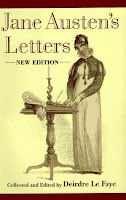
An  epistolary novel, for those who are unaware of the term,  is a  novel  written as a series of documents, usually through diary entries. Although the aforementioned titles are not fictional, they do read as though they could have been. Epistolary novels such as  The History of Sir Charles Grandison, Clarissa, and Pamela were amongst Jane's favourites, and she even wrote one of her first books, Lady Susan , in the same style. Though T.H. White did not publish any epistolary work, he certainly read a great deal of it, as he had to do for his book The Age of Scandal , and subsequently fell in love with the time period during which this style of novel was most prevalent.  Jane's letters, comprised of daily accounts directed to her sister Cassandra, her publisher Mr Barry, her niece Fanny Knight, her best friend Martha Lloyd, and her friend Jame Stanley Clarke, detail everything about her world but little about her personal sentiments. Ca...

Reading the Classics: Review of T.H. White's "Mistress Masham's Repose"

Image
Many know of Swift's "Gulliver's Travels", but not many know "Mistress Masham's Repose". As one is a political missive and the other a children's book, one should wonder what the two have to do with one another, but though Mistress has been hailed and marketed as a middle grade story, the writing style, historical themes, and allusions to Swift's work make it enjoyable for anyone with good sense and the willingness to enjoy historical fantasy. "Mistress Masham's Repose" tells the story of Maria, a young girl of large fortune who is orphaned and forced to live on her parent's derelict estate. She is left under the care of a cruel governess and curator, and her only friends are the estate's cook and her Latin professor. She spends most of her time dodging her enemies and hiding around the estate, but one day while her nemeses are away, she discovers a remote civilization of Lilliputians, the same Lilliputians described by ...

Reading the Classics: Review of Paul Creswick's "Robin Hood"

Image
Many belonging to the older generations are usually familiar with "The Merry Adventures of Robin Hood" by Howard Pyle, but not many are familiar with the even older "Robin Hood" or "The Adventures of Robin Hood" by Paul Creswick. Those who have seen the Disney film by the same time would know of it, as the film was based on Creswick's interpretation (minus the foxes). The book, though fanciful in its own right, focuses on the more historical aspects of Robin Hood (or Robin Whode or Wood). Many have marked  Robin Hood as a high-minded  Saxon  fighting  Norman  lords, and some have even gone so far as to try to trace his possible lineage to a Robert Fitz'Ooth, a Saxon-Norman lord and ranger's son. Here is where Paul Creswick's story begins, for though many would claim that the name Robin Whode was a name taken by many Saxon outlaws in the day as a motto for the under-trod peasantry, Creswick blends the slender historical value of Robin ...

Reading the Classics: Review of T.H. White's "The Candle in the Wind"

Image
"The King was on the threshold. He came in, the quiet old man who had done his best so long. He looked older than his age, which was considerable. His royal eye took in the situation without a flicker. He moved across the cloister to kiss Mordred gently, and smiled upon them all." -- The Candle in the Wind, chapter 2 As the books of "Once and Future King" go on, the fourth and what was almost the last book in the series discusses the last few weeks of King Arthur's reign. This is a heartrending book, and one of T.H. White's most beautiful. In it, he tries to reconcile Arthur to a life of peace, Lancelot to a life of virtue, and Guinevere to a life of tranquility. All three characters have been living with their own private vexations for almost fifty years at this point: Lancelot feeling he has failed his king by the rift of the Round Table, Guinevere feeling that she has failed herself by marrying one man while preferring another...

Reading the Classics: Review of T.H. White's "The Ill-Made Knight"

Image
I did a review of "Once and Future King" by T.H. White earlier in the week, but because the third book in the series, "The Ill-Made Knight", is my favourite one of the five, I felt a separate review was necessary. We all know the story of Lancelot: King Arthur's most intimate friend, one of the greatest knights of the round table, handsome, skillful, clever, fell in love with Gwynevere, etc. Malory's Morte D'Arthur shows us the gallant and prepossessing side of the famous knight,. but T.H. White's depiction gives us a new and possibly more realistic view of what it may have been like to be Arthur's champion and friend. Galahad Lancelot Dulac was born a hideous child. Learning to be ashamed of himself at an early age, he is determined to prove his worth to the world. Abused and alone, Lancelot is shown kindness from Arthur at an early age, and once he is asked if she should like to become a valiant knight of the Round Table one day, Lance, as ...

Reading the Classics: Review of Jane Austen's "Mansfield Park"

Image
When had I first read Mansfield Park a few years ago, I was unable to finish it. I felt it began well and had all the powers of intellectual stimulation that Jane's novels usually afford, but then the matter of the play always stifled my enjoyment. For those who have never read it, the characters contrive to put on a play called "Lovers' Vows", which is supposed to foreshadow all the romantic horror that happens in the third volume, and though the play has its purpose, I -for some unknown reason- disliked it so much that I either didn't finish the book, as happened the first time, or skipped over it entirely, as happened the second time. The third time I read the book, something in my little brain clicked and Mansfield Park became one of my favourite Jane Austen novels. It tells the story of Fanny Price, a young woman who has the unfortunate business of being born in a large, poor, middle class family. She is adopted by the Bertrams, her family of cousins occupy...